


There’s a question I’ve been asking for years, and I want to ask it here before I tell you anything about conference tickets or timings:
Who taught you that your distress was your fault?
Because someone did. Maybe it was a clinician who told you your anxiety was a “feature of your autism”, or a school that called your child’s shutdown “behaviour”, perhaps it was a workplace that offered you a wellbeing app whilst refusing to turn the lights down; it could even have been you, at 3am, deciding that the problem must be you because everyone keeps saying so.
The 2026 Autistic Mental Health Conference exists because I don’t believe that story. Neither does anyone speaking at it.
The Theme: Ecosystemic Causes Of Mental Health Issues
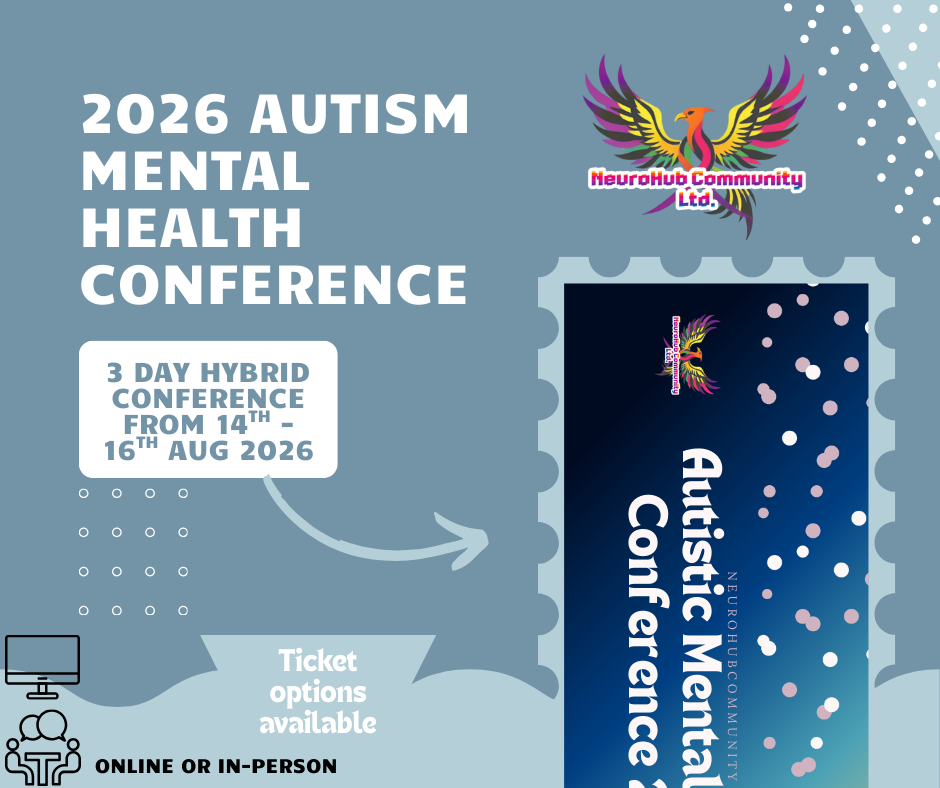
Three days. 14th–16th August. The whole event is built around one argument; Autistic distress is not a symptom of being Autistic, it is a response to environments and systems that were never built for us.
That is a structural claim. If distress is ecosystemic, then individual treatment alone will always be insufficient; the school, the workplace, the benefits system, the therapy room and the family home are all clinical sites. If distress is ecosystemic, then a lot of professionals are going to have to change what they do.
Tanya Adkin and I will be presenting the Ecosystemic Model of Distress on Friday afternoon, the framework we’ve spent years developing to explain this, but we’re one talk out of dozens.
Who else is speaking
Dr. Nick Walker on unorthodox approaches to Autistic psychological resilience. If you’ve read Neuroqueer Heresies, you know why this matters.
Natasha Leahy on late identification as systemic harm: the trauma of not knowing.
Dr. Nathan Keates on power and meaning in Autistic mental distress.
Ava McAuley on masking, the Double Empathy Problem, and why burnout isn’t a personal failure.
Erin Ekins on growing up queerly Autistic: fresh from the BBC after her book was at the centre of a school ban.
Meryem Cetinkaya on autism, suicidality, and co-created care.
Karen Parker on the “performance over health” school culture that breaks children before anyone intervenes.
Jessica Dark on workplace stress as an organisational design problem, not an employee problem.
Emily Nuttall on AuDHD, eating disorders, trauma and addiction — lived experience, unflinching.
Plus Jess Nicks, Lawrence Kampf, Sarah Meharg, Ed Shearer, Nic James, Nikki Smith, Stacy Badon, Amber Dawn, Harry Mansfield, and an entire on-demand library of talks we couldn’t fit into the schedule. In total there are more than 20 speakers.
Every one of them neurodivergent or working directly alongside neurodivergent communities. This is a conference about us, by us.
What it costs, and how to get in
We built this hybrid on purpose, because an inaccessible conference about accessibility is a joke.
NeuroHub Connect members get 33% off every ticket. Membership is free. Join the community, contact our admin team for your code, use it at checkout. There is no catch and no reason not to.
Friday and Sunday are online. Saturday is live in Brighton with stalls, food and entertainment; and livestreamed for everyone who can’t travel. All talks are recorded and available to ticket holders afterwards for 6 months, so if your capacity collapses on day two, you haven’t lost anything.
Now the part I actually want from you
I don’t want you to read this and quietly close the tab; I want a discussion, so:
1. What’s the single environmental thing that damages your mental health most; and what would it take to change it? Not the diagnosis. the thing. The open-plan office, the school run, the DWP letter. Name it.
2. Professionals: what were you taught about Autistic mental health that you’ve since had to unlearn? I’ll go first; I was taught that distress was a deficit to be managed. It isn’t, it’s information about the environment.
3. Parents: when did you first realise the system was going to make you fight for basic humanity?
4. What talk isn’t on our programme that should be? We’re already thinking about next year.
Drop your answers in the comments. Post them on your own feeds., tag us. Share this post with the one person who keeps insisting your burnout is a personal resilience problem.
We’ve got five days. The conversation starts now, and it doesn’t stop when the last session ends on Sunday.
See you there.

3 responses to “Your Mental Health Was Never Just Yours”
Hi, will the sessions at the conference be recorded? The talk topics sound amazing, but I’m in New Zealand, so everything will be happening in the middle of the night my time. I’m recovering from burnout and don’t have the capacity to watch them live. Thanks
Hello,
Yes, ticket holders will have six months access to the recordings
Being unable to leave the house independently. People’s reactions to my vocal stimming (even if I try not to be loud). Being unable to work full time. Being unable to drive. People not understanding sensory issues. People assuming I must not have moderate support needs.