


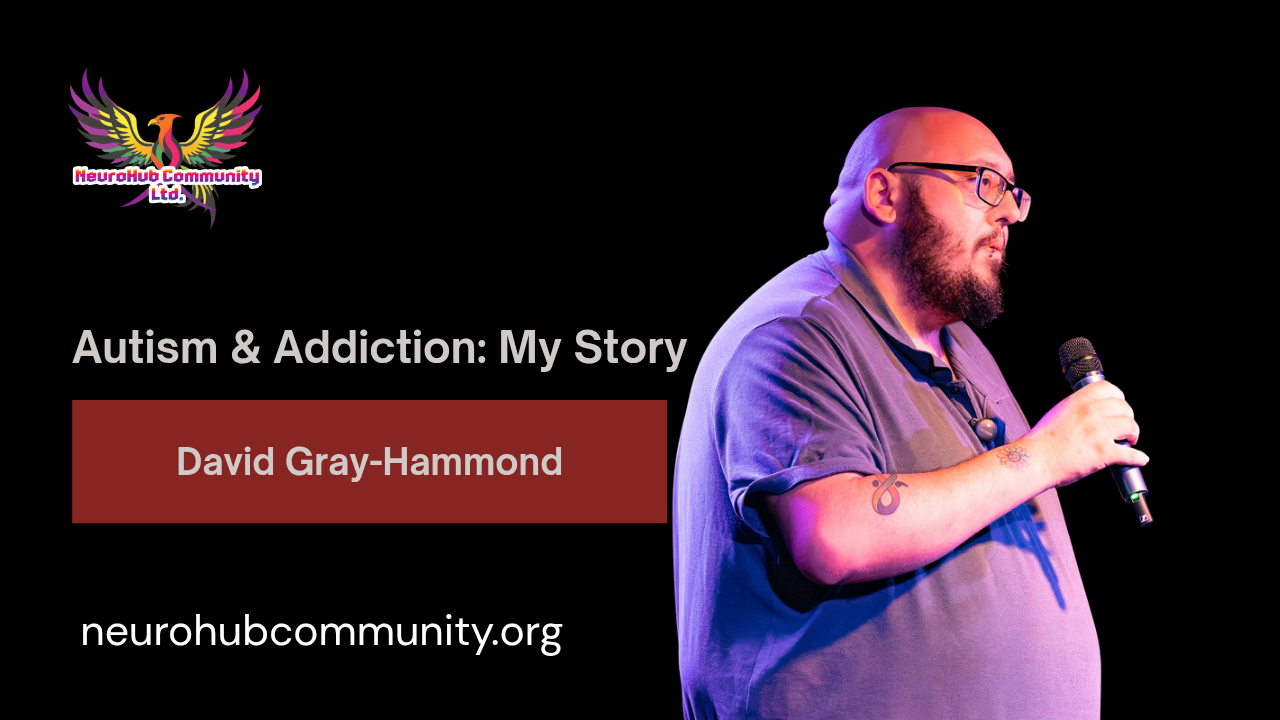
I spent the first eighteen years of my life feeling like a broken neurotypical. The most common thing I heard from teachers and professionals was that I was incredibly intelligent, but failing to meet my full potential. People expected great things of me. I could not see how to get there. I did not even know what it was that was expected of me; only that, whatever it was, I was not managing it.
Underneath that was a great deal of childhood trauma, and an Autistic ADHD neurocognitive style that nobody had named. My mental health was declining rapidly. I was hearing voices and living with paranoia. The institutions and power structures around me would not acknowledge my needs, let alone accommodate them.
That is the ecosystem I was using drugs and alcohol in. I think we have to start there, because almost every conversation about addiction starts at the crash, and by then the most important part of the story has already happened.
What The Drugs Were Actually Doing
Substances were not a failure of character. They were a solution, and for a long time they were an extremely effective one.
They made the burden lighter; they quietened the hallucinations and stopped me circling my paranoia, regulated my sensory environment for me when nothing else would, and they gave me a relational world, a community of other users where we could bond over the ridiculous things that happened while we were drunk and high, seek out and experiment with whatever we could acquire, and, together, discover that human consciousness was boundless.
They also gave me something I have only been able to articulate since; a legible identity. When I behaved neurodivergently, people attributed it to the drugs rather than to difference. David the drug user was more acceptable to the world than David the Neurodivergent person. Which is absurd when you think about it, that is an entire society telling you which version of yourself it is prepared to tolerate.
More than anything, though, they took the soul-crushing feelings of fear and failure and turned them off. A line, a pill, a pipe, and it all melted away almost instantly. My fear of dying is really a fear of oblivion, and substances handed me agency over that oblivion; I could choose it, in doses, on my terms.
If you are trying to understand why someone uses, that is the question to sit with. Not “why can’t they stop”, but “what is this doing that nothing else in their life is doing”.
The Turn
I did not notice the change as it happened. It was fast, but it was subtle, looking back, I can trace it to my lung collapsing when I was twenty-two. A spontaneous pneumothorax, brought on by everything I had smoked, and by being tall and underweight, which is a significant risk factor in itself.
While I was recovering from that I developed pneumonia and pleurisy, and I was prescribed tramadol for the pain. I remember the first dose exactly; it was like being wrapped in a warm, cosy blanket and looking out at the world through rose-tinted glasses. It was perfection.
Around the same time, my psychiatrist put me on diazepam.
I want to be careful here, because this is the part of my story that people find least comfortable. My addiction did not escalate because street dealers got to me. It escalated because medicine handed me a better, cleaner, more reliable version of the solution I had already found. By the end I was taking over 200mg of diazepam a day alongside lorazepam, clonazepam and etizolam, drinking liquid morphine and oxycodone like soft drinks, and adding whatever else I could get hold of. What I could not get prescribed, I sourced illicitly. I became genuinely skilled at managing doctors into giving me what I wanted.
My life became an experiment. I kept detailed journals of what I had taken, in what quantities, in what combinations, and what it did. I was chasing an idealised state of consciousness, a precise point where my mind was in just enough oblivion to forget how frightened of dying I was. I woke up every day and tried to induce myself into a coma, somewhere between the world of the living and no longer existing.
Pieces Of Descartes’ Machinery
The obvious question is how nobody noticed. The UK medical system is the opposite of holistic. It is a series of experts in very specific pieces of Descartes’ machinery, each of them rarely looking beyond their own piece. Nobody was holding the whole picture, and that was the opening. The fragmentation of my care created the exact conditions in which I could present whatever each service needed to see in order to give me what I wanted.
I did not outwit a joined-up system, I moved through the gaps in a disjointed one. It was only when I finally recognised that I needed help that the parts began to join up at all, and even then it took years before anyone took the bodymind approach that would actually get me near recovery.
Matter And Anti-Matter
The first time I knew I was in serious trouble was when I stole my mother’s post-operative oxycodone prescription to stop myself going into withdrawal. Around then I also started having frequent seizures, most likely because I was smoking around seven grams of spice a day on top of everything else. So I asked for help. What happened? Substance use services told me they could not treat me effectively while my extensive mental health needs went unmet. Mental health services labelled me with a personality disorder and told me they would not work with me until I stopped using.
Those two services behaved like matter and anti-matter. They annihilated each other on contact, and took my hope of recovery with them. It is worth saying plainly what that label meant in context. An undiagnosed Autistic, ADHD man with a substantial trauma history, in acute distress, presenting in ways nobody had the framework to read, was recorded as having a disordered personality. Not an unmet need, nor a nervous system under siege. A disordered personality. I know how many people reading this will recognise themselves in that sentence.
Waking Up In Resus
Two things eventually broke the deadlock. The first was a good care co-ordinator who pushed services to take responsibility for their part, even when they only did so minimally. Never underestimate what one person willing to make a nuisance of themselves can hold open.
The second was a huge overdose and seizure. I woke up in the resuscitation area of my local emergency department. I was discharged, went home, told my mother and my sister I was going into detox, and phoned my key worker at the substance use service. Within a week I was an inpatient on the detox ward of the local psychiatric hospital. That was the point at which the true extent of the mental health damage became fully visible. I did a further six months of community detox, and my first day of recovery was the 7th of April 2016.
Thirty days later I had my first full psychotic episode, and spent another month as a psychiatric inpatient. That episode lasted several months.
I include that because recovery writing almost always leaves it out. Getting into recovery did not make things better first. It made them considerably worse before anything improved, because the substances had been doing real work and stopping them meant meeting everything they had been holding back, all at once, without them. If that is where you are, you have not failed at recovery; you are in it.
Finding My Neurokin
In November 2016 I was diagnosed Autistic, and my life changed in ways I could not have dreamed of. The diagnosis was the moment I understood that I was not broken; I simply had not found my people yet. I started writing a blog about autism and addiction, and that is how I found them. The writing got me invited into spaces. I formed genuine connection with others like me, I learned what a life on my own terms could actually look like.
Being in community with other neurodivergent people was the single most important part of my recovery, and it is precisely why I do the work I do now. I would not have survived without this community. I owe the Autistic community a life debt that I am happy to repay for the rest of my days. Please notice the shape of that, because I think it is the most useful thing in this entire piece. Substances had given me regulation, a community and an identity I could live inside. What eventually replaced them was not willpower. It was a truer identity and a real community, doing the same job honestly. You cannot take someone’s only solution away and offer them nothing in its place.
Ten Years On
I fight a war in my head every day.
My brain still tries every route it can find to convince me I am not strong enough to survive without using. What I have learned over time is that my recovery is what I make of it, and that with daily practice and real attention to where my head is, I can stay in it, and support the community I love, my children I adore, and my family who mean more to me than I can put into words. This was what made being a mindfulness practitioner such a natural arc for my ongoing story.
The hardest part is the guilt. I cannot let go of the pain I caused in addiction, and I have stopped expecting to. Every day I wake up committed to being a little better than I was the day before, but recovery is a daily battle. You take it one step at a time, and that is what makes it doable.
To You, If You Are Still Using
You have not failed, you are not broken. You have spent too long in an ecosystem that is hostile to you, with far too little help to shoulder that burden. What you are doing makes sense as a response to that. The problem was never that you were not trying hard enough.
To Clinicians, Services And Commissioners
If I could change one thing, it would be this; addicts can be difficult, I was difficult. You need to see beyond the challenging presentation, because that is a human being in front of you, and nobody chooses a life of addiction. They deserve exactly the same compassion and respect as any other seriously suffering person.
Addiction costs lives. When it does, it is far more often a systemic failure than a personal choice. Stop making people qualify for help by first solving the problem they came to you for. Stop letting your service and the one next door cancel each other out, somebody has to hold the whole picture.
For eight years, nobody held mine. For ten years I’ve been fighting to stop that happening to others.
If you have found this article valuable or relatable, please consider joining our heartbeat community “NeuroHub Connect”, purchasing access to the on-demand recordings of our Autistic Mental Health Conference 2026, or supporting us on Ko-Fi.
