


Most advice about supporting Autistic people is aimed at the wrong thing. It looks at behaviour. It asks how to make an Autistic person calmer, quieter, more compliant or easier to be around. It rarely asks the question that really needs asking; what is this person living inside?
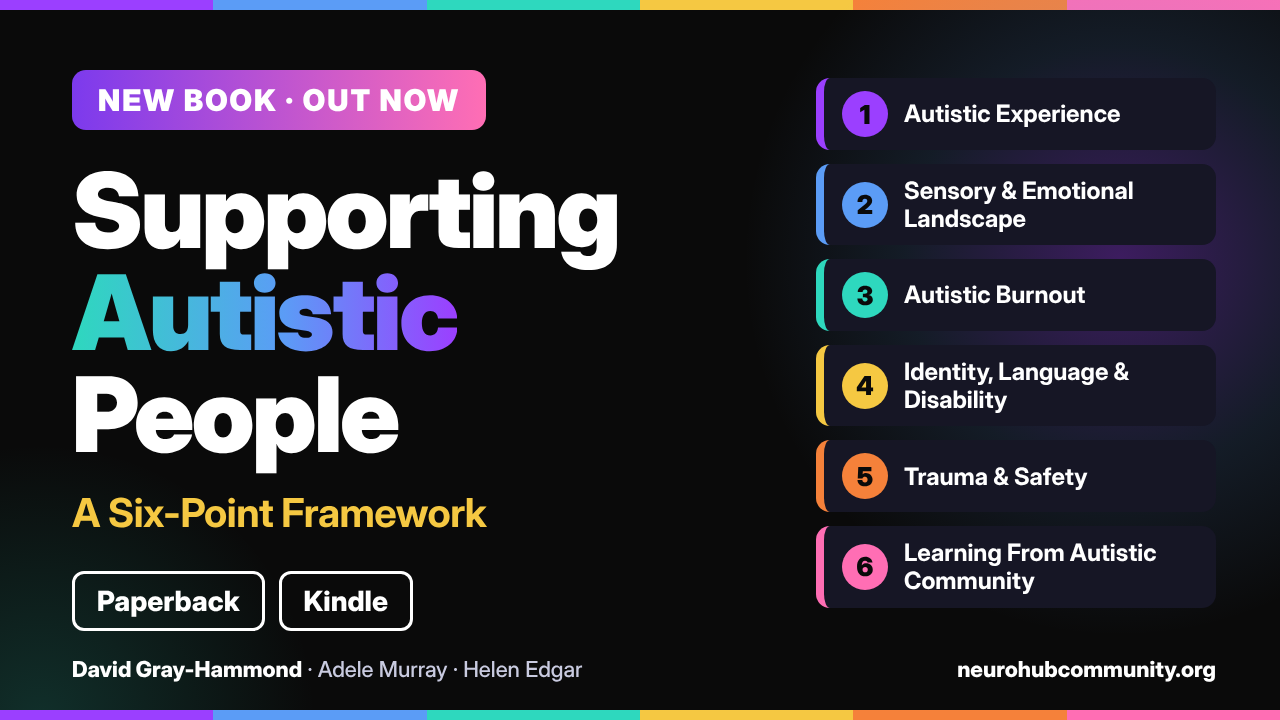
That question is the heart of our new book. As of today, Supporting Autistic People: A Six-Point Framework is available in paperback and on Kindle.
What Is Supporting Autistic People?
Supporting Autistic People: A Six-Point Framework is a practical, Autistic-led guide to understanding what is really going on for the Autistic people in your life, and what genuinely helps.
I wrote it with contributions from Adele Murray and Helen Edgar. It sets out the six-point framework that underpins all of NeuroHub’s peer mentoring and wellbeing work. I developed that framework over ten years of working alongside Autistic people, and it is rooted in knowledge the Autistic community has built up over decades.
The book takes an ecological approach. It doesn’t treat Autistic wellbeing as a list of deficits to manage, rather, it looks at how wellbeing is shaped by layers of environment that interact with each other. Put simply:
Autism + Environment = Outcome
If you change the environment, you change the outcome.
The Six Points
- Autistic Experience: the foundations of how Autistic people perceive and move through the world, including monotropism.
- The Sensory and Emotional Landscape: sensory load, emotional demands, and why “overreacting” is usually a reasonable reaction to an unreasonable environment.
- Autistic Burnout: burnout as a crisis of long-term disconnection, and how to spot it before it becomes a crisis.
- Identity, Language and Disability Models: how autism gets framed, why those framings matter, and what masking costs.
- Trauma and Safety: what trauma looks like for Autistic people, and what real safety requires.
- Learning From The Autistic Community: why Autistic people are the experts on Autistic lives.
Who Is This Book For?
We wrote it for anyone who wants to support an Autistic person well:
- Parents and carers who are tired of advice that makes home feel like a behaviour programme
- Autistic adults who want language and structure for their own experience
- Teachers, SENCOs, and teaching assistants
- Support workers, social workers and health professionals
- Managers and employers who want to get it right for Autistic staff
You don’t need any background knowledge. The book is written to be practical first, and the theory is there when you want to go deeper.
Why We Wrote It
Too much autism support is still built on compliance. Its success is measured by how well an Autistic person hides their distress, not by whether that distress has gone down. The results are predictable: masking, burnout, trauma, and Autistic people being blamed for the ecosystems that are harming them.
This also raises a question about knowledge. Who gets believed about Autistic lives? Too often it isn’t Autistic people, this book is our answer to that. It is written by Autistic and neurodivergent people, and it draws on the collective knowledge of our community. It is meant for anyone ready to move from fixing towards understanding.
Paperback Or Kindle?
- Paperback: ideal for annotating, keeping on the staff room shelf or passing round a team
- Kindle (£12.99 in the UK): read it in minutes, on any device with the Kindle app
Both are available now through one link: mybook.to/sup-autistic
Help Us Get This Book Where It’s Needed
Independent, Autistic-led books don’t have big publishing budgets behind them. They rise or fall on community support. If you’d like to help:
- Buy a copy this week. Early sales push the book up the Amazon rankings, so more people find it.
- Ask your local library to stock it.
- Get copies for your school, service or team. For group orders or training built on the framework, email admin@neurohubcommunity.org. We can arrange bulk deliveries at a lower cost per book.
Want to go further?
The six-point framework is also the foundation of Re-Storying Autism, our Autistic-led online course with Helen Edgar. If the book resonates, the course is the natural next step. You can explore all our courses and the rest of our book store.
Frequently asked questions
What is the six-point framework for supporting Autistic people?
It is NeuroHub Community’s model for understanding Autistic wellbeing. It covers Autistic experience, the sensory and emotional landscape, burnout, identity and language, trauma and safety, and learning from the Autistic community.
Is the book neurodiversity-affirming?
Yes. It is Autistic-led, uses identity-first language, and rejects deficit-based and compliance-based approaches.
Is it suitable for professionals?
Yes. It is written for families and professionals alike, and the framework is already used in our training and peer mentoring work.
Is there an audiobook?
An audiobook is in the works. Join our newsletter, to hear when it’s out.
The Conditions For Flourishing
Autistic people don’t need to be fixed. We need more sustainable conditions; environments that make room for how we think, feel and connect, and supporters who are curious rather than corrective.
This book is one small contribution to building those conditions. I hope it changes how you see the Autistic people in your life. I hope it changes what you ask for them, and what you ask of the world around them.
David Gray-Hammond is the founder and CEO of NeuroHub Community, an Autistic and multiply neurodivergent author, and a consultant with over a decade of experience working in and around neurodivergent communities.
