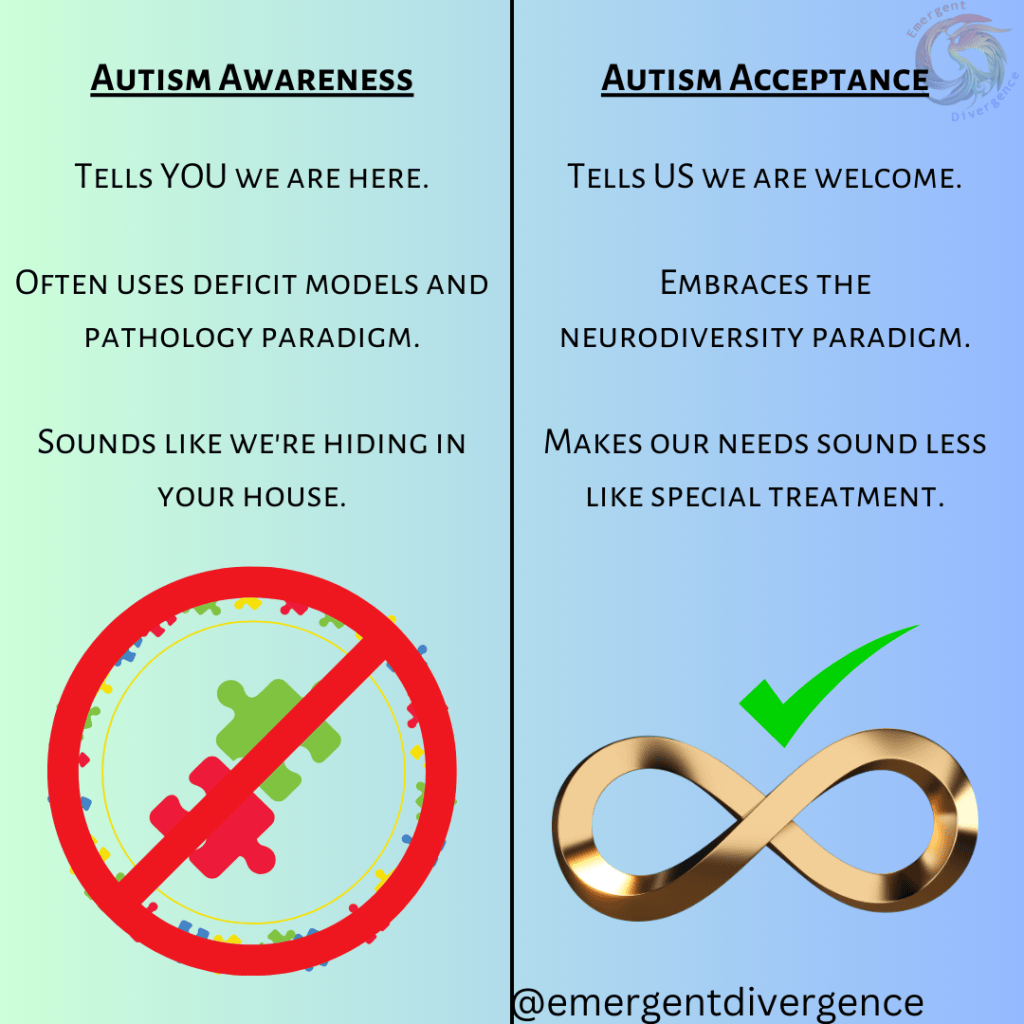
One of the big discussions around April is the way we use this month. Should it be “Autism Awareness Month” as recognised by wider society, or should we embrace it as “Autism Acceptance Month”? My personal opinion is that we should always be led by the community. However, to understand the narratives surrounding April I wanted to dive into the various discourses that exist online. To better understand the general feeling of the internet.
What Are Big Charities saying about Autism Awareness Month?
I will start by saying that I am intentionally ignoring Autism Speaks. Their harmful and performative nature is such that I do not wish to give them a platform. Despite this there are a number of other Charities and non-profits that have opinions on this topic. First we have a charity that has started using the “autism acceptance” language.
In 2024, we’re asking everyone to get as colourful as possible with their amazing fundraising. Join us and thousands of other brilliant people in schools, workplaces and local communities to raise vital funds and help create a society that works for autistic people.
Celebrate World Autism Acceptance Week by doing your own 5k Spectrum Colour Walk in a place and at a time that suits you. If walking is not for you, you can find lots of ideas on our resources page to help you fundraise your own way!
National Autistic Society Website
I feel that this quote is a good starting place for understanding why awareness has been hijacked. NAS here are openly using April as a fundraising opportunity. While fundraising is an important part of no-profit activities, this is an organisation that has a mixed history and supports Positive Behavioural Support (PBS). Despite it’s appearance, PBS is the same as Applied Behavioural Analysis (ABA) and is a deeply concerning thing to see.
Similarly the Autism Society starts leads with requests for money. It would seem that for many of these bigger charities, April is more about the money than the people it claims to exist for.
Autistic Led Charities and Non-Profits
I would start with Autistic Inclusive Meets here in the UK (of whom I am a patron). This organisation amplifies the voices of Autistic people on it’s social media and it’s website is very focused on what they are doing for Autistic people. It is a very different vibe to the bigger charities.
Next we have Neuroclastic in the US, another Autistic led non-profit. Similarly to AIM, they do not plaster requests for donations all over their website, they just go about their business of publishing the voices of Autistic people, including this article written by myself in 2021 regarding my views on Autism Acceptance Month.
To round up my collection of non-profits that focus on the people more than the month, here is Aucademy. Aucademy do extensive work on educating people, and are once again Autistic led. This organisation again focuses on acceptance over autism awareness month.
Blogs and Publications about Autism Awareness Month/Autism Acceptance Month
Ultimately, the goal of Autism Acceptance Month is to be more inclusive of the community it seeks to celebrate. It promotes not just education about the differences of people with autism but understanding and respecting them.
Delano (2024) for Autism Parenting Magazine
This particular article talks about the shift from autism awareness to autism acceptance and it’s importance for dismantling stigma around this topic. I myself have discussed the impact of reframing autism awareness month discourse into one of autism acceptance and the work we still require. All articles mentioned in this section were at the top of the google search to try and avoid my own biases.
Further Blogs
The Neurodiversity Movement has made a lot of progress in changing the way we think about autism and other neurological differences such as dyslexia, depression, etc., but autistic people still face a lot of challenges due to discrimination and lack of accommodations
Inclusive Employers Website
This is important to talk about, and they do go further to discuss that Autistic people are notoriously under- or unemployed. Autism Acceptance Month is framed as a progression from autism awareness to one where we have more equal access.
In promoting acceptance and further research into autism spectrum disorder, the quality of life in those on this spectrum may hopefully improve. A 2018 study in the Journal of Autism and Developmental Disorders suggested that experiencing acceptance may benefit mental health, while lack of acceptance may correlate to depression and stress.¹¹ Acceptance from people around those with autism spectrum disorder also improved self-acceptance, which correlated with greater self-esteem and lower depression.
Fiorillo (2024) for Neurology Advisor
You will notice that a lot of these offerings, despite advocating for autism acceptance, still use very medicalised language. However it is interesting to see so many places reframing themselves away from the traditional language of Autism Awareness Month.
Conclusions
There is a growing push to shift away from Autism Awareness Month into Autism Acceptance Month. While I agree that awareness has it’s place, it is often a domain where people speak over us rather than listen to us. Whatever your preferred name for April, we can all agree that it’s necessary to do more work to demedicalise and destigmatise autism. Autistic people still do not have equal access to the world, and it’s time that changed.